
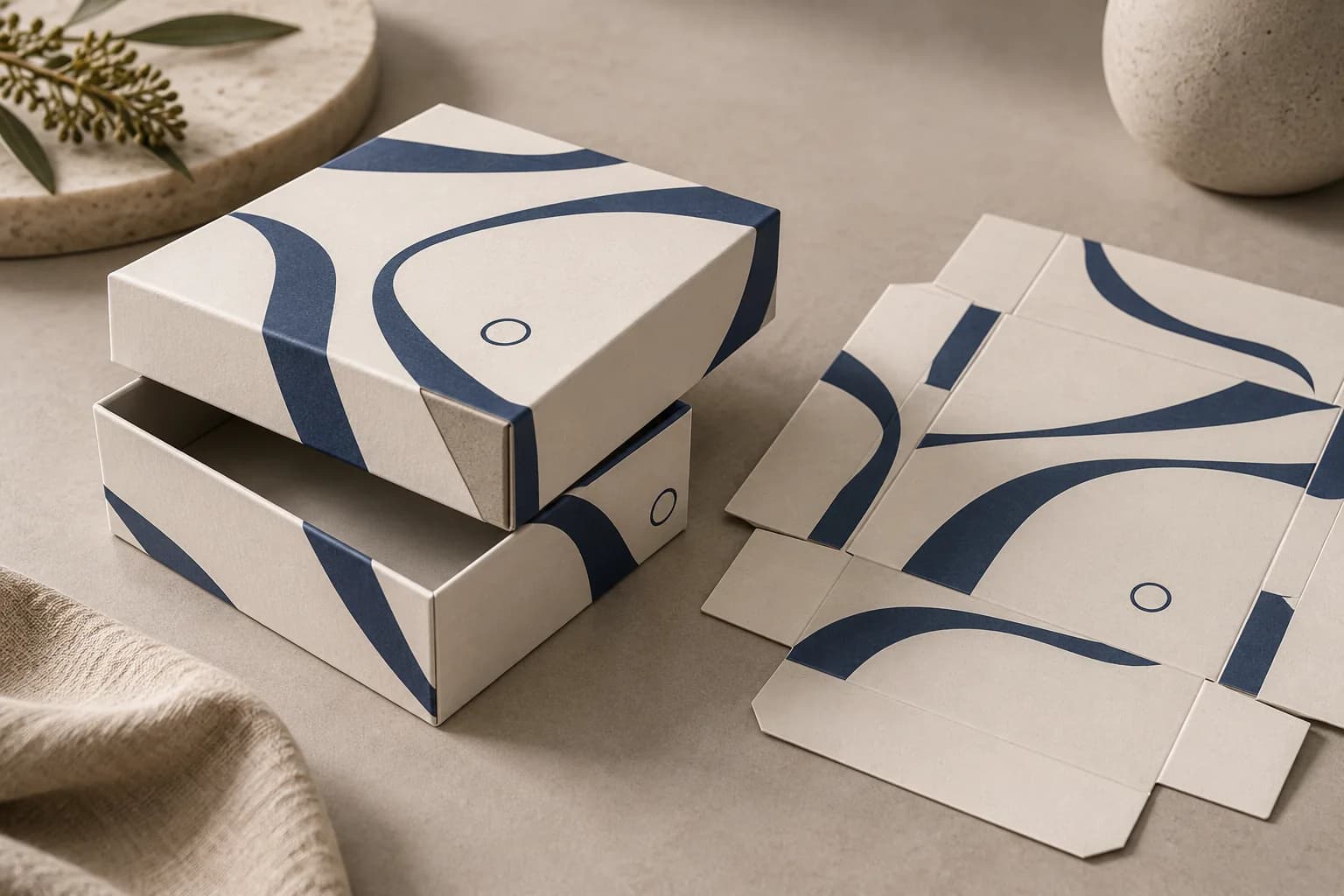
Read the design on the box, not only on the flat file
For a rigid box made with grey board, approve the printed wrap in the position in which the buyer will see and open the finished package. A flat file can look balanced while a side panel reads upside down, an important detail turns inside the lid, or the closed lid hides the base artwork. The purchasing question is which face carries each message after wrapping and assembly.
YOUNGSUN's grey board is a structural material. The visible decoration may come from a separate printed or specialty facing. Keep core-board selection and wrap-artwork approval as distinct records, and identify the converter responsible for the finished box. A material quotation does not automatically include printing or box assembly.
Agree on the front and opening direction
Start with the intended display position: on a shelf, lying flat, or presented with the lid removed. Ask the packaging designer to mark the front, back, top and opening direction on the structural reference. Use the same viewpoint when reviewing the artwork; avoid descriptions such as “left side” without saying who is looking at the box and from where.
For a lid-and-base construction, identify the two components separately. Record which edge the customer lifts first and which side faces the customer. For another box style, obtain that converter's own panel map. Do not transfer the panel orientation from an unrelated template simply because the finished dimensions look similar.
Mark each printed panel on the applicable wrap template
PackMojo's rigid-box dieline guide illustrates wrap material extending around greyboard edges into the interior. It also distinguishes the reading directions of lid and base panels. Use that guidance as a reason to request the selected converter's orientation map, rather than copying another box's panel rotations.
Make a short review list using the current template:
- Where is the principal graphic on the lid top?
- Which way should the wording read on each side when the box is displayed?
- Does a repeated motif continue onto an inner fold, and is that intentional?
- Which artwork belongs to the lid, the base and any separate insert?
Give each file and component an unmistakable version identifier. If the designer changes the opening direction, reopen the panel review rather than relying on the appearance of the previous flat proof.
Check the closed and open views separately
A graphic that is visible with the lid removed may be covered when the box is closed. Review both conditions, including the actual depth of the proposed lid and the position of any labels or sleeves. State where essential product information must remain visible in the intended presentation.
Use an assembled mockup to compare the top view, customer-facing side and inside view against the marked panel map. Walk through the opening sequence. These are proposed buyer checks, not a dimensional registration standard or a guarantee that every printed edge will match perfectly.
Ask about edge coverage without inventing a universal margin
Packhelp's artwork advice explains why backgrounds intended to cover a box face need bleed. Its dimensions belong to its own workflow. Request the chosen converter's requirements for bleed, safe areas, turn-ins and joins on the actual construction; do not apply a generic number to every rigid box.
Show where a design is meant to stop and where the background should continue. Ask the converter to identify areas that become hidden or overlap during wrapping. If a thin border or continuous line is important to the design, discuss its placement on the assembled sample before approving it.
Keep structure and appearance decisions connected
Use the existing grey-board thickness and GSM guide for the structural specification. This article does not select a board thickness or promise a particular wrap tolerance. A printed mockup should identify the core, facing material and finishing operations it represents; record any substitutes so an early visual sample is not mistaken for final production approval.
Keep the marked template, approved artwork and identified assembled reference together. Recheck the affected views when box dimensions, lid coverage, wrap layout or opening direction changes. Send grade, sheet format, quantity and destination requirements to the paper supplier; send the artwork and finished-box criteria to the responsible converter. Explore the packaging-board range or share the material specification with those responsibilities made clear.
Buyer questions
Does approving grey-board thickness approve the printed wrap?
No. The structural material and the visible artwork answer different purchasing questions. Review the printed panels on the assembled box as well as the grade-specific material specification.
Can the same panel map be used for every rigid box?
Do not assume so. Use the selected converter's current template for the actual box style, component dimensions and opening direction.
Does a flat digital proof show which artwork the lid will hide?
Not necessarily. Compare the closed and open assembled views with the panel map, and identify the materials and operations represented by the sample.