
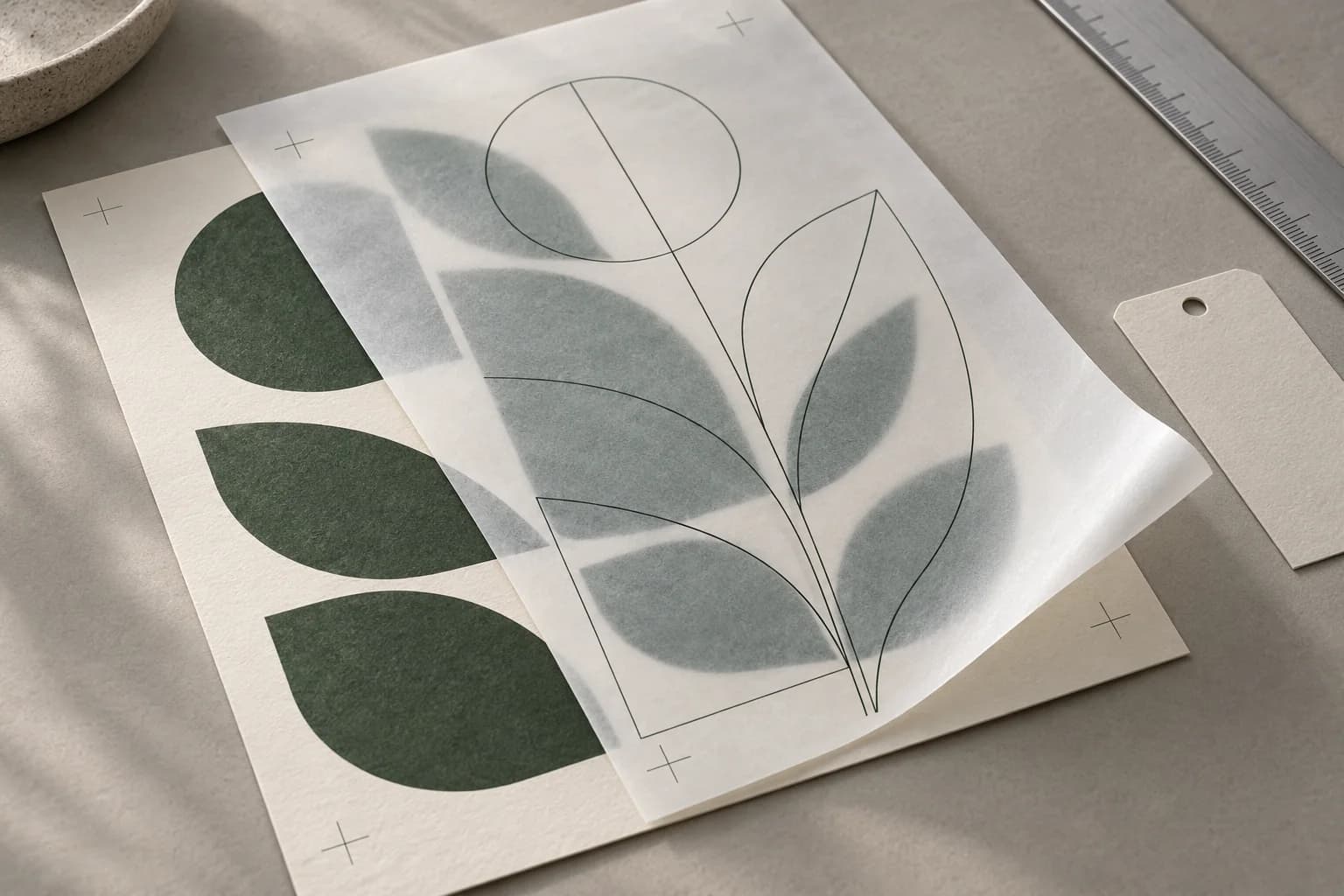
A tracing paper overlay should be approved on top of the actual underlying artwork, in the intended finished position. Review alignment and readability separately: a perfectly positioned sheet may still obscure a caption, while a readable design may sit incorrectly after folding or binding.
For a purchasing team, the useful approval item is an identified two-layer sample, accompanied by the artwork revision and an agreed way of judging the result. A loose translucent sheet and a screen preview answer different questions.
Start with the assembled design
Translucent paper changes what the viewer sees beneath it. ONLINEPRINTERS' material guide describes the underlying design showing through and advises considering contrast. Its stock and printing choices belong to its own offer; they do not establish specifications for another supplier's paper.
Before asking for a trial, identify which information is printed on the upper sheet and which belongs to the lower sheet. Mark where the two layers must relate: a window around a logo, a line continuing into an illustration, or an overlay that deliberately softens a background while leaving essential text clear. These examples are design-review prompts, not promised production effects.
YOUNGSUN's Tracing Paper range provides the material starting point. Confirm the selected grade and intended process with the converter rather than treating every tracing paper as interchangeable.
Give the converter a physical reference for position
Define how the upper sheet will be located in the finished piece. Is it loose, held at one edge, folded around a cover, or included in a bound assembly? The sample should reproduce that arrangement closely enough to answer the purchasing question.
Ask the converter to identify the reference edge, trim position and attachment or fold location on the proof instructions. Agree which visible relationships matter and how a deviation will be assessed. Do not invent a universal millimetre tolerance: the acceptable result depends on the artwork, construction and converting process.
A useful check is to move the loose overlay away and return it to its intended position. If the design only works after careful hand adjustment, ask whether the actual assembly method can reliably locate it. This is a trial question for the converter, not evidence that a production run will fail.
Keep position and visibility as separate decisions
| Review | Sample arrangement | Approval question |
|---|---|---|
| Alignment | Upper and lower artwork in the intended assembly | Do the agreed visual reference points line up? |
| Readability | Final text, images and background under the selected sheet | Is the information that must remain legible clear enough? |
| Finished handling | Sample with the intended fold or attachment | Does normal opening and closing change the result? |
| Version control | Labelled physical sample and matching files | Can purchasing and production identify exactly what was approved? |
Use the intended viewing arrangement for the comparison. If a presentation is meant to be opened, review it open as well as closed. If a particular background is part of the design, include it. An empty white backing is not a substitute for a dark, detailed printed page when that is what will be supplied.
Request a relevant production trial
Gmund's printing tips for its Colors Transparent range recommend proofing on the same stock and testing printing or processing in advance. Those are brand-specific instructions, not a certificate of compatibility for YOUNGSUN material. They support asking for a trial that uses the chosen paper and intended process.
If the assembled proof does not work, record the reason before changing the paper order. A shift between layers calls for a positioning review. Text obscured by the combined graphics may need an artwork change. A printing or finishing problem needs the converter's process review. Changing GSM alone is not an approval method for all three situations.
Compare revised samples against the same underlying artwork and assembly instructions, and identify every changed variable. Keep the approved sample together with its file revision; otherwise a later purchase may refer to an attractive proof that no longer matches the production files.
What to include in the sample request
Send the selected paper grade or requested sample options, finished sheet dimensions, upper and lower artwork files, printing process, intended attachment or fold, and the visual relationships that require approval. Name the person responsible for approving the assembled result and record the agreed acceptance method.
For material selection, browse Printing & Culture Paper. To discuss the paper and sample information for a project, contact YOUNGSUN. Printing suitability, assembly capability and acceptance requirements still need confirmation for the specific job.
Buyer questions
Is a PDF proof enough to approve the overlay?
Use the PDF to confirm files and artwork revisions, then review a physical assembled sample when the approval depends on the actual paper, underlying print and layer position.
Does tracing paper GSM define how clearly the lower design will appear?
GSM alone does not establish the approved visual result. Compare the selected grade with the actual lower artwork and intended assembly rather than assigning a universal visibility value.
Who should set the alignment tolerance?
The buyer, designer and converter should agree the relevant visual reference points and acceptance method for the specific construction. This guide does not prescribe a universal numerical tolerance.