
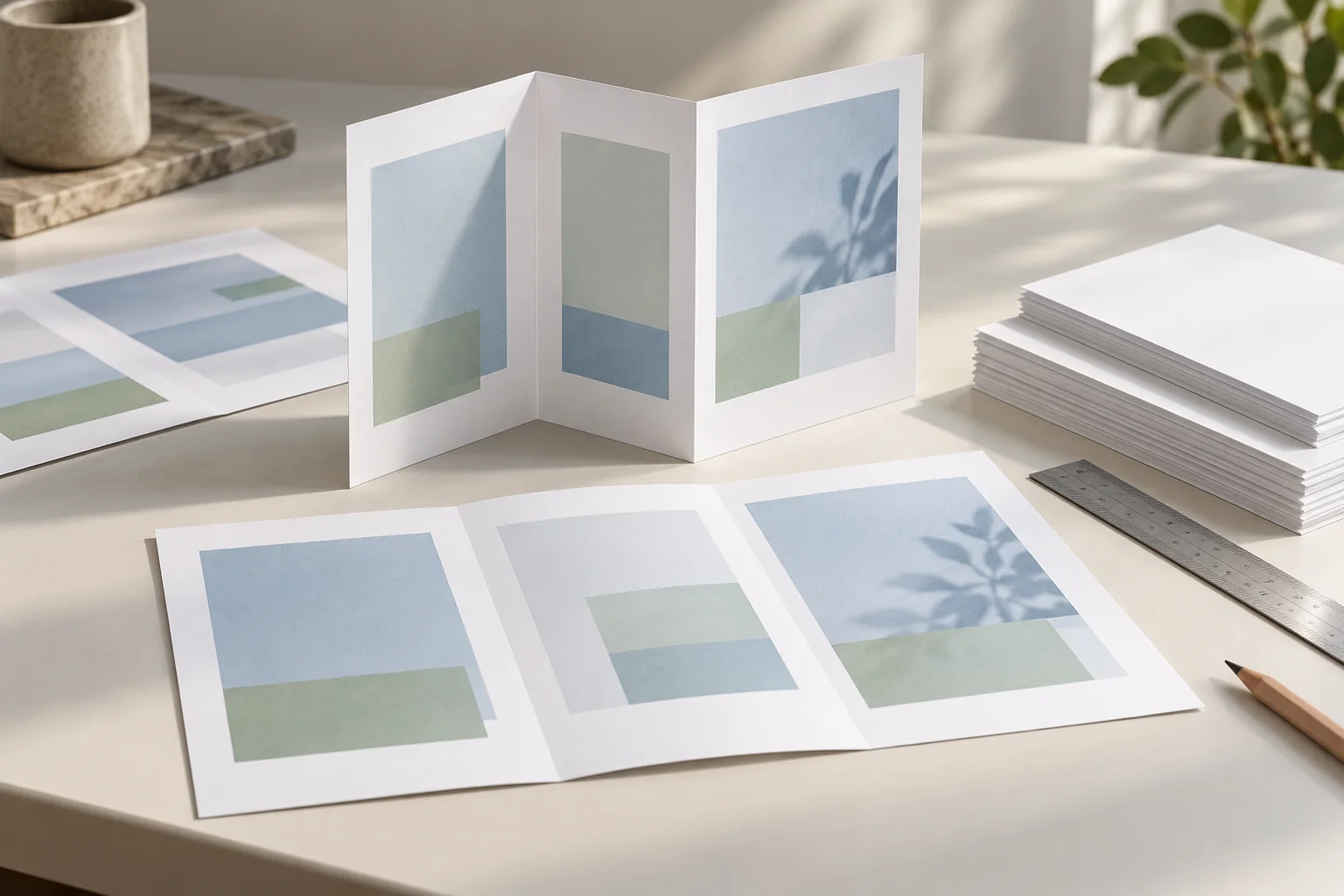
Approve the folded object before the sheet layout
For a leaflet made from coated art paper, approve a physical folded dummy before treating the paper size and artwork layout as final. Check which panel opens first, where the reverse-side content lands, and whether the closed piece fits its intended space. A flat PDF can show the graphics clearly while leaving those relationships untested.
This guide addresses the approval sequence for a commercial-print leaflet using a selected double-side coated grade. It does not prescribe one grammage or fold setting for every job. YOUNGSUN's C2S art paper page describes paper coated on both faces for commercial print; the exact finish and grade still need their own specification and trial.
Give the blank dummy a limited approval role
Start with the proposed paper, open size, fold style and finished size. Mark each face and panel, then fold a blank sample in the intended sequence. If the exact stock is not yet available, identify the substitute prominently and keep material approval open.
Use this stage to answer practical layout questions: Does the cover face outward? Does the reader meet the information in the right order? Is a panel trapped inside another fold? Can the closed leaflet be inserted and removed from the intended carton, sleeve or presentation piece?
These are approval questions, not a standard test method. The converter should establish the production dimensions and allowances. As a separate manufacturer's planning example, Fengyi's folded-leaflet guidance asks buyers to confirm panel sequence and finished size with the artwork. Its manufacturing services are not YOUNGSUN supply commitments.
Add the printed and finished proof
A blank dummy cannot approve colour appearance, small text beside a crease or the behaviour of printed folds. Request a representative proof using the planned paper, print process and finishing route. Identify which operations the proof includes and which remain to be trialled.
Inspect the piece both open and closed. Compare the intended reading order with the artwork file; look at text, images or rules crossing a fold, and examine printed areas at the fold after the agreed handling. Ask the printer to explain any mismatch between the proof route and the planned production route.
Paper alone does not determine the finished fold. Sappi's Fold Endurance technical note identifies paper characteristics, printing, bindery processes and environment as relevant factors. This older technical reference is background, not evidence of recent market demand or a performance guarantee for another supplier's grade.
Keep grain direction and layout in the same discussion
Ask the paper supplier to identify the proposed sheet's grain direction, and ask the converter to record how the planned folds relate to it. Review that information before approving an economical sheet layout. Rotating artwork to use a sheet differently may also change the fold arrangement that was sampled.
Avoid a universal instruction that every leaflet must follow one fold direction. Sappi's note distinguishes lightweight and heavyweight situations and discusses scoring and printed coverage. The useful purchasing action is to obtain a grade-specific converting recommendation and an identified physical result, rather than copying another job's settings.
Record exactly what the signature approves
Keep an approved dummy and proof with a short record:
- Paper supplier, grade, finish and grammage, plus the sample identity.
- Open and closed dimensions, panel order, front/back identification and opening direction.
- Artwork version, planned print and finishing operations, and proof limitations.
- Grain direction and proposed sheet layout as confirmed by the responsible suppliers.
- Appearance checks, agreed acceptance reference, approver and date.
A layout or paper change should reopen the affected checks. Do not let an approval of panel sequence silently become approval of colour, fold quality or bulk production consistency.
For a quotation, send these requirements with quantity, supply form and destination. Use the printing and culture paper range for material context, or the woodfree-versus-C2S comparison if the surface choice is still open. Contact YOUNGSUN to discuss paper requirements; agree the printed-leaflet approval with the responsible printer or converter.
Buyer questions
Can a flat PDF replace a folded dummy?
It can support artwork review, but it does not physically demonstrate the opening sequence, closed dimensions or fit. Approve those on an identified folded sample and keep the scope of each approval clear.
Is C2S art board interchangeable with C2S art paper?
Do not assume so from the shared C2S description. Confirm the actual grade, grammage, caliper and intended conversion. A board sample is not automatically a representative paper-leaflet proof.
What needs checking again after a sheet-layout change?
Ask the converter to identify changes to panel position, fold sequence, grain relationship and finishing. Repeat the affected dummy or printed-proof checks before extending the earlier approval.