
Introduction
Woodfree offset paper and C2S art paper can both run through offset printing, but they are designed to produce different visual and tactile results. Choosing between them is not simply a matter of “matte versus glossy.” The coating structure changes ink holdout, smoothness, colour appearance, drying behaviour, fold response, opacity, bulk and finishing options.
The quick answer is:
- Choose woodfree offset paper when readability, writing feel, natural texture, book bulk or economical text reproduction matters most.
- Choose C2S art paper when image detail, colour density, surface smoothness and premium catalogue or brochure presentation matter most.
- Do not approve either family by GSM alone. Compare the actual mill grade, finish, bulk, opacity, whiteness, grain direction and press/finishing route.
Official product catalogues illustrate why grade-level confirmation matters. UPM describes its Fine offset grade as a woodfree uncoated product for high-speed web and sheet-fed offset applications, while its sheet-fed coated range is positioned for realistic images and vivid print results. Published target values vary by product and are explicitly described as informative and subject to production variation. That is the right procurement mindset: use category knowledge to shortlist, then use the selected mill data sheet and a press trial to approve.
What do WFU and C2S mean?
Woodfree uncoated offset paper
“Woodfree” is an industry grade description and does not mean the sheet contains no wood-derived fibre. It generally refers to paper made primarily from chemical pulp, with relatively low mechanical-pulp content. “Uncoated” means there is no mineral coating layer engineered to create the very smooth surface associated with art paper.
The surface remains more open and tactile. Ink penetrates and spreads differently than on coated paper. This can support comfortable text reading and a natural appearance, but it usually produces less gloss and lower apparent image sharpness than a comparable coated sheet.
Common uses include books, manuals, forms, stationery, envelopes, inserts, reports and text-led direct mail. The exact grade may also be designed for laser, inkjet or other processes, so “offset paper” should not be treated as proof of universal digital compatibility.
C2S art paper
C2S means coated two sides. A coating—typically containing pigments and binders—is applied to both surfaces and finished to a gloss, silk, satin or matt appearance. The smoother, less absorbent printing surface can hold ink closer to the top of the sheet, supporting fine image detail, strong colour and a more uniform appearance.
Common uses include catalogues, brochures, annual reports, magazine covers, advertising pieces, art books and premium inserts. “Art paper” is a broad trade term; always state whether you need gloss, silk or matt and whether the material will be folded, laminated, varnished or bound.
Quick comparison table
| Decision factor | Woodfree offset paper | C2S art paper |
|---|---|---|
| Surface | Uncoated, more tactile and porous | Mineral-coated on both sides, smoother |
| Typical strength | Text readability, writing feel, natural look, bulk | Image detail, colour density, smooth premium presentation |
| Ink behaviour | More absorption; dot gain must be managed | Greater ink holdout; press settings and drying still grade-specific |
| Finish options | Machine-finished, smooth or supercalendered depending on grade | Gloss, silk/satin or matt |
| Typical applications | Books, manuals, forms, stationery, envelopes | Brochures, catalogues, magazines, promotional print |
| Writing/overprinting | Often suitable, subject to grade and ink/toner test | Coating may reduce pen, toner or variable-data adhesion |
| Folding risk | Fibre cracking depends on GSM, grain and ink coverage | Heavier coated grades may need scoring to prevent fold cracking |
| Key purchase checks | opacity, bulk, roughness, formation, moisture | smoothness, gloss, coating integrity, pick resistance, fold/score response |
How the surface changes the printed result
Text and reading comfort
For long-form text, an uncoated sheet often feels calmer because it reflects light more diffusely. The tactile surface is familiar for books and manuals. Opacity is especially important when printing on both sides: show-through can reduce readability even when the sheet meets the expected GSM.
Coated matt or silk papers can also be readable, but the design should consider surface reflection, image coverage and lighting. Do not assume that “matt” means completely non-reflective; gloss values and viewing conditions vary by grade.
Photography and colour
C2S art paper normally provides a smoother image-reproduction surface. Fine screens, small reversed type and saturated photography can appear cleaner, provided the press profile and ink limits suit the paper. A coated product data sheet may include recommended characterisation data, ICC profile information, total area coverage and screening guidance. These are production inputs, not decorative details.
Woodfree offset paper can produce attractive colour, especially when a natural or editorial look is intended. The design and prepress setup should allow for greater ink absorption and a different colour gamut. A proof on coated stock does not accurately predict an uncoated production result.
Tactile and brand effect
Uncoated paper often communicates warmth, authenticity or practicality. Coated art paper can communicate precision, polish and image intensity. Neither is automatically more premium. The correct choice is the one that supports the brand, content and finishing route without unnecessary material or process cost.
Technical properties a buyer should compare
Grammage
Grammage is determined under standards such as ISO 536:2019. It helps define sheet mass and product category, but equal-GSM papers can differ significantly in thickness, opacity and stiffness.
Thickness and bulk
Bulk describes volume per unit mass and is particularly important in books. A higher-bulk uncoated paper can achieve a thicker spine without proportionally increasing mass. Coated papers are often denser, although high-bulk coated grades exist. Use the grade data, not a generic assumption. ISO 534:2011 provides methods for thickness and related density calculations.
Opacity
Opacity limits show-through. It should be evaluated with the intended ink coverage, lighting and page design. Thin papers for books or manuals may require careful opacity selection even if their basis weight is commercially standard.
Whiteness, brightness and shade
These measurements describe different optical properties and should not be used interchangeably. A blue-white sheet can make some colours appear more vivid but may be unsuitable for a warm editorial design. Approve shade under controlled viewing conditions and specify how lot-to-lot variation will be managed.
Roughness and smoothness
Surface measurements help predict print contact and ink behaviour. The method matters: values obtained by Bendtsen and PPS methods are not directly interchangeable. Compare like with like and use the printer’s experience with the press configuration.
Moisture and dimensional stability
Paper should be protected during transit and conditioned before printing. Curl, wavy edges and dimensional movement can disrupt feeding, registration and finishing. Keep reams or reels wrapped until the material has acclimatised according to the supplier’s guidance.
Grain direction
Grain direction affects folding, binding, stiffness and dimensional movement. For bound products, the preferred grain direction often runs parallel to the spine, but the printer or binder should confirm the imposition. Put the direction on the order and packing labels.
Choose by application, not by category name
Books and manuals
Start with reading comfort, opacity, bulk, binding method and page count. Woodfree offset is a common choice for text pages. A coated insert section may be used when photographs require greater detail. Mixed stocks must be planned with the binder because thickness and folding response differ.
Brochures and catalogues
C2S art paper is often selected for photography and brand colour. Consider whether the piece will be mailed, folded, saddle stitched or perfect bound. A heavier cover may need scoring; a laminated cover needs an adhesion trial.
Forms, stationery and overprinting
Uncoated offset paper is usually the better starting point when handwriting, stamps, laser personalisation or office printing is expected. Still test the exact printer, toner, ink and drying conditions. Surface sizing and moisture can influence runnability.
Premium editorial projects
A high-quality uncoated sheet can be more appropriate than gloss art paper when the desired result is tactile and understated. Conversely, a silk-coated sheet may balance image quality with lower glare. Ask for printed dummies rather than making the decision from a blank swatch alone.
Press, finishing and binding considerations
Offset press setup
The printer should receive the mill's prepress and print recommendations. Coated and uncoated papers may require different ICC profiles, ink limits, fountain-solution control and drying expectations. The UPM Fine offset product information and UPM sheet-fed coated range demonstrate the grade-specific nature of these values.
Folding and scoring
Grain direction, GSM, coating, ink coverage and fold geometry all influence cracking. Heavy or densely printed art paper often benefits from scoring before folding. Test the actual printed construction, not an unprinted blank.
Lamination, varnish and foil
Surface energy and coating integrity affect adhesion. If the job includes film lamination, water-based or UV varnish, foil, glue or labels, run compatibility tests with production materials. A visually good print can still fail later if the finishing system is not validated.
Binding
Perfect binding depends on paper, ink, grain direction, spine preparation and adhesive. Saddle stitching has different thickness and creep constraints. Share page count, trim size and binding method when requesting paper recommendations.
Planning a paper or board order?
Send us your application, format and target specification.
Send your requirementsA practical print-test and approval workflow
1. Define the job
Record final trim size, page count, print process, colour coverage, finishing, binding, quantity and target market. Identify whether the material must accept handwriting, toner or inkjet overprinting.
2. Shortlist by mill data
Compare grammage, thickness/bulk, opacity, whiteness/shade, smoothness, gloss, moisture and available formats. Confirm which values are typical and which are guaranteed.
3. Obtain representative samples
Request samples from the proposed grade and finish. A gloss sample cannot approve a silk product, and an 80 GSM sample cannot validate a 150 GSM folding job.
4. Print a controlled test form
Include neutral grey, skin tones, saturated colours, fine text, reverses, gradients and representative total ink coverage. Use the intended press profile and record settings.
5. Complete the finishing route
Fold, score, laminate, varnish and bind as required. Inspect cracking, rub, set-off, adhesion, curl, colour consistency and page handling after adequate drying or curing.
6. Approve and retain standards
Keep an approved printed sample, signed shade reference and purchase specification. For repeat orders, define how lot changes will be assessed rather than relying only on the grade name.
Logistics and shipment inspection
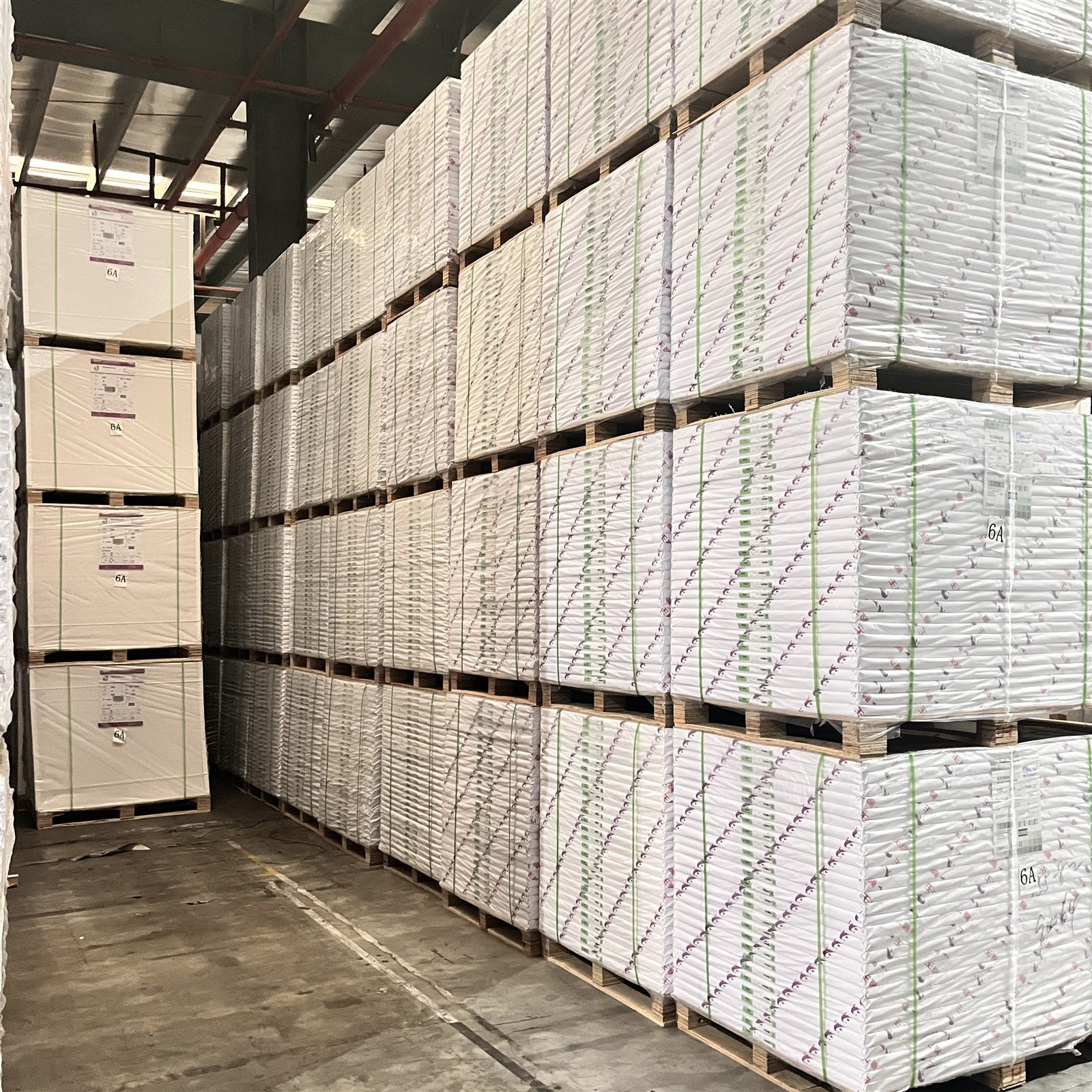
Paper can meet its mill specification and still create press problems if it is damaged in transit. For sheets, inspect ream wrapping, pallet condition, corner protection, sheet count, size, grain marks and signs of moisture. For reels, check reel ends, edge damage, wrapping, core condition, diameter and label traceability.
During container loading, photograph the dry, clean container; pallet placement; blocking and bracing; and final door closure. Do not load paper against visibly wet floors or damaged container walls. Agree any desiccant use and moisture barrier with the logistics and product teams rather than treating it as a universal remedy.
RFQ checklist for comparable quotations
- Grade family: woodfree uncoated offset / C2S art paper.
- Finish: machine-finished, smooth, gloss, silk or matt.
- GSM and acceptable tolerance.
- Sheet size or reel width; grain direction.
- Printing process and press type.
- End use, page count and trim size.
- Colour coverage and critical image requirements.
- Folding, scoring, lamination, varnish and binding.
- Quantity and delivery schedule.
- Destination and packing requirements.
- Certification and documentation requirements.
- Sample, trial reel or press-test requirement.
FAQ
Is art paper the same as offset paper?
No. In common trade use, art paper is coated for a smoother print surface, while woodfree offset paper is uncoated. Both may be printed by offset lithography, so the printing method alone does not make them equivalent.
Which paper is better for colour printing?
C2S art paper is usually the stronger starting point for high image detail and colour density. Woodfree offset paper can be excellent when a natural appearance or text-led design is desired. “Better” depends on the target result and press profile.
Which paper is better for books?
Woodfree offset paper is widely used for text pages because of readability, opacity options and bulk. Image-heavy art books may use coated paper. Page count, binding, spine thickness and finished weight should be considered together.
Can I compare papers by GSM only?
No. Also compare thickness or bulk, opacity, shade, smoothness, stiffness and the intended finish. Equal-GSM papers can produce different spine thickness, show-through and press behaviour.
Is gloss art paper always more expensive?
Not necessarily on a total-job basis. Price depends on grade, GSM, quantity, market and format. Also consider ink demand, spoilage, drying, finishing, postage and yield. Request comparable specifications before comparing quotations.
Can C2S paper be written on or laser printed?
Some grades and devices may work, but coating can affect toner, ink and pen adhesion. Test the exact paper, printer and consumable. Do not assume general compatibility from the term C2S.
What sample should an international buyer request?
Request the actual grade, GSM and finish; then ask for a small press trial or printed reference relevant to the job. For reels or high-volume production, agree a trial quantity and acceptance criteria before the main order.
Conclusion
Woodfree offset paper and C2S art paper solve different communication problems. The reliable decision begins with the printed product: how it should look, feel, fold, bind and perform. Category names help create a shortlist, but grade data, representative samples and a complete press-and-finishing trial make the purchase specification dependable.
CTA — Ask for a Paper Match: Send YoungSun your end use, GSM, dimensions, print process, finish, quantity and destination. We can organise a woodfree offset or C2S art paper proposal in sheets or reels for comparison.