
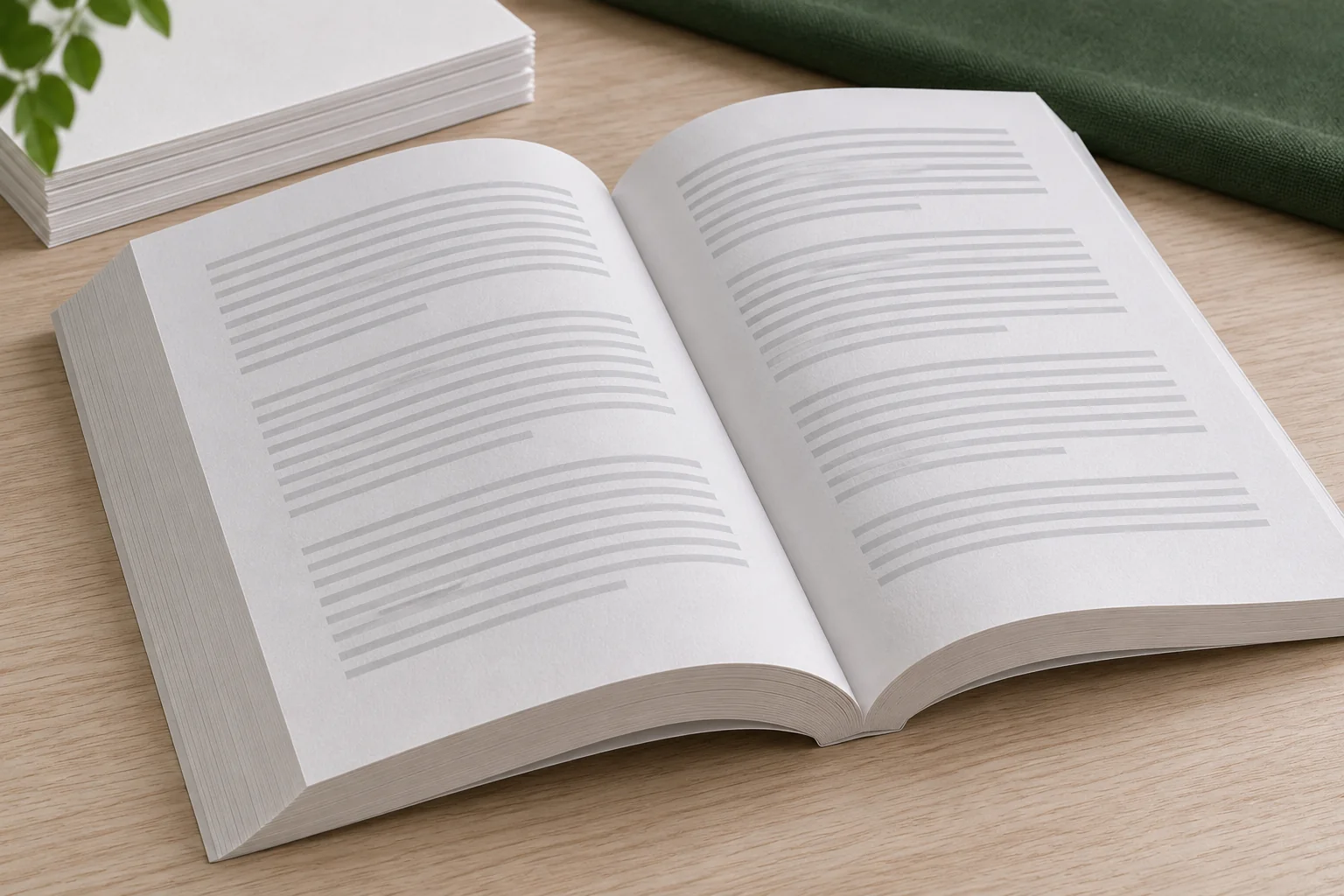
When selecting woodfree paper for a book, read the intended content in a representative bound proof. A loose printed sheet can show text clearly while leaving unanswered what the reader will see near the spine after binding. Agree the proof construction and the content to inspect before approving the material for the job.
This guide concerns the inner reading area of the finished book. It does not prescribe a universal gutter width, promise lay-flat opening or approve a binding process from the paper name alone.
Define what the bound proof represents
Give the printer and binder the intended trim size, page count, binding construction and artwork revision. Identify the paper grade, grammage and other agreed material references. State whether the proof uses the proposed production material or a substitute. A substitute can help answer a layout question, but any difference must remain visible in the approval record.
An electronic spread is useful for discussing the layout; it is not the same object as an assembled book. IngramSpark's User Guide, Version 3.3 dated August 24, 2026, recommends reviewing electronic and printed copies in its own publishing workflow. That recommendation does not establish that its equipment accepts a YoungSun grade or that its production limits apply to your binder.
Ask which decisions the proof can support. A dummy with blank pages may help discuss construction, but it cannot show whether a caption or line of text remains readable. A printed proof using another stock may reveal content placement while still leaving the proposed paper-and-binding combination unapproved.
Read the content where the pages meet
Open the proof in the way the binder intends it to be used. Look at the inner margin without treating a forced-flat opening as evidence of normal reading access. If a page needs unusual pressure to expose important content, record the observation and ask the binder to review it; do not assume that changing paper alone will solve it.
Blurb's guidance on two-page spreads addresses its perfect-bound books, excluding its Layflat books, and warns that material placed in the central gutter may be hidden or appear misaligned after binding. It identifies page count, position within the book and paper thickness among the factors involved. This is background for requesting a representative proof, not a transferable margin formula.
Inspect ordinary text as well as the most attractive opening spread. Include captions, page references and any graphic that approaches or crosses the inner area. A continuous line or photograph can make a mismatch noticeable; a small word can be important even when it occupies very little space. Record the affected spread and content rather than writing only “book looks good.”
Use identified spreads and a short record
Choose inspection points with the printer or binder. As an editorial starting point, include representative openings near the beginning, middle and end, along with the content that is most sensitive to loss near the spine. This is not an acceptance-sampling standard or a claim that those positions cover every defect.
Keep a concise record:
- Proof identity: title or project code, artwork revision, date and proof reference.
- Construction: trim size, page count and the binding arrangement represented.
- Material: the exact proposed paper grade and whether the proof actually uses it.
- Reading observation: spread or page reference, affected text/image and how the proof was opened.
- Decision: accepted scope, required change and who must review the revised proof.
Separate a layout issue from a material or binding question. Moving a caption away from the spine is a design decision. Confirming a different stock or binding construction requires the responsible supplier or converter to review that combination. Avoid turning one successful opening into approval of every page or every future edition.
Connect the proof to the purchase order
Retain the accepted proof reference with the material specification and the current artwork. If the page count, paper grade, layout or binding construction changes, identify which approval questions need to be checked again. Do not carry an approval across those changes without discussion.
YoungSun woodfree offset paper is an uncoated printing-paper family used for book interiors and other publishing work. Confirm the selected grade with your printer and binder; the family description does not promise a particular opening behaviour or finished-book result.
Send the paper requirements with the intended construction and proof observations. The printing and culture-paper range provides material context. Keep book manufacturing requirements with the converter who will make the finished book.
Buyer questions
Does a readable loose sheet approve the bound gutter?
No. It does not show the assembled reading area near the spine. Review the intended content in a representative bound construction and identify any material substitution.
Is there one gutter width that suits every woodfree-paper book?
This guide gives no universal width. Ask the printer or binder for requirements appropriate to the actual page count, trim size, paper and binding construction.
Should an earlier proof cover a change of paper or binding?
Do not assume so. Identify the changed construction or material and agree which reading and production questions require a revised proof.