
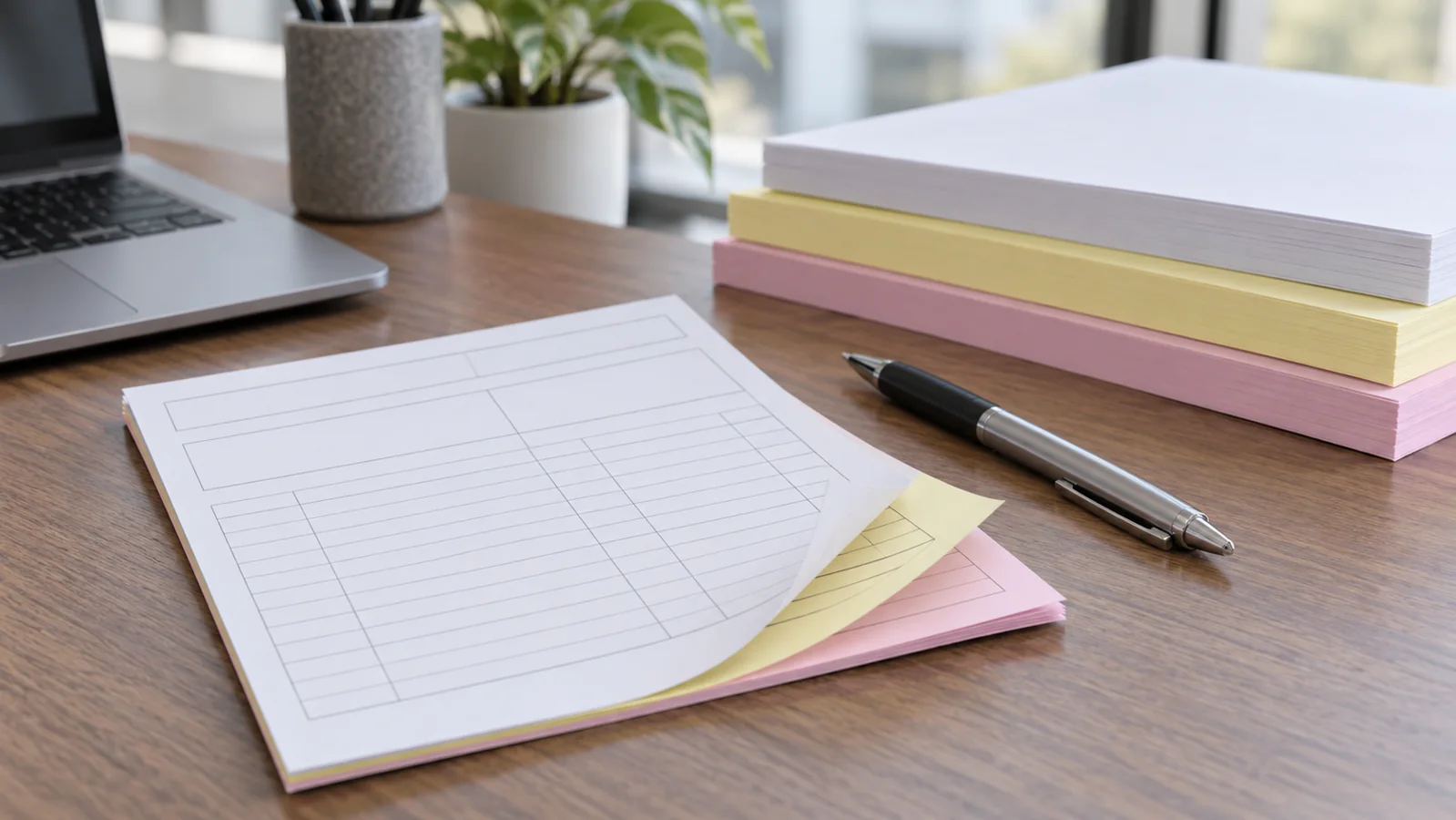
NCR paper: start with the role of each sheet
Specify NCR paper as a complete copying set, not simply a stack of coloured sheets. The top, middle and bottom positions need the correct coated faces in contact. Before comparing quotations, define the number of parts, their sequence in the finished form and the printing and collating process.
For a conventional multi-sheet system, a two-part set uses CB above CF. A three-part set places CFB between them. That arrangement describes the form when it is being completed; it does not automatically describe the order in which your printer must feed the sheets.
What CB, CFB and CF actually mean
Koehler's technical explanation of carbonless paper describes a pressure-activated reaction between coatings. CB has the transfer coating on its back, CF receives the image on its front, and CFB receives on the front while passing the information onward from its back.
The independent SEF guide to carbonless forms corroborates these positions in a typical multipart form. Both are technical background sources. Their proprietary grade performance, equipment approvals and commercial conditions are not specifications for YOUNGSUN paper.
Use the letters to identify function:
- CB — coated back: the top sheet in the conventional set.
- CFB — coated front and back: an intermediate sheet when the set needs that position.
- CF — coated front: the final receiving sheet.
Paper colour can help staff identify copies, but it is not proof of coating type. Put both the colour and the CB, CFB or CF designation in the specification.
Translate the required copies into an orderable construction
First ask the end user how many sheets the completed transaction needs. “Two copies” is ambiguous: it can mean two sheets in total or an original plus two copies. Write the total number of parts explicitly.
For example, an original and one receiving copy means a two-part CB–CF construction. An original plus two receiving copies typically means CB–CFB–CF. These are conventional construction examples, not a promise of legibility for a particular grade or operating condition.
If more intermediate sheets are proposed, ask the supplier and converter to evaluate the intended set. Do not infer an unlimited number of readable copies merely because CFB can occupy a middle position. Agree the copy requirement and verify it in a representative sample.
Keep finished-use order separate from feed order
The completed form's top-to-bottom sequence is one record. Printer loading, sheet delivery and collator settings are another. Ask the printer to confirm the feed and output orientation for the actual process before ordering precollated material.
When buying NCR carbonless paper in reels or large sheets, state who will print, cut, collate and bind it. When requesting a finished set, show the required final sequence and face orientation. Confirm which supply and converting stages the quotation actually includes.
A useful annotated sample identifies the first sheet, each intermediate sheet and the last sheet. Label the sample references in the approval record rather than relying on a verbal colour sequence alone.
Investigate a faint or missing copy in the finished form
Start by confirming the actual sheet identities, facing direction and sequence. Then ask the converter to evaluate the form using the intended writing or impact method and normal support arrangement. Record which position and which field fails to reproduce clearly.
Do not treat a faint bottom copy as proof that the paper needs a higher grammage. Preserve the grade references, printing process, form artwork and relevant trial conditions so the parties can investigate the construction together. Agree acceptance criteria before approving the sample; this guide provides no universal copy-count limit, writing-pressure threshold or image-life guarantee.
If toner or another digital printing process is planned, confirm suitability for the exact paper grade and equipment separately. Approval for one carbonless product does not establish approval for another.
Put the essential decisions in the RFQ
Send the supplier the total parts per set, top-to-bottom CB/CFB/CF sequence, colour of each part, grade documents required, supply format and dimensions. Add the intended printing, collation and use process, requested quantity and destination.
Keep an approved complete set linked to the order, not just separate loose sheets. Review changes to paper type, sequence, printing or finishing against that reference. Explore our printing and culture paper range, application guidance, or send your form requirements for a material enquiry. Confirm availability and commercial terms for the specific proposal.
Frequently asked questions
Is a three-part NCR form the same as three copies plus an original?
No. A three-part form has three sheets in total. State the total number of sheets and the intended receiving copies explicitly in the order.
Can colour identify whether a sheet is CB, CFB or CF?
No. Confirm the coating designation and facing direction for each position. Colour alone does not establish the sheet's copying function.
Does the finished form sequence tell me how to load the printer?
No. Confirm printer feed, output orientation and collator settings separately, then verify the finished set in its intended use order.