
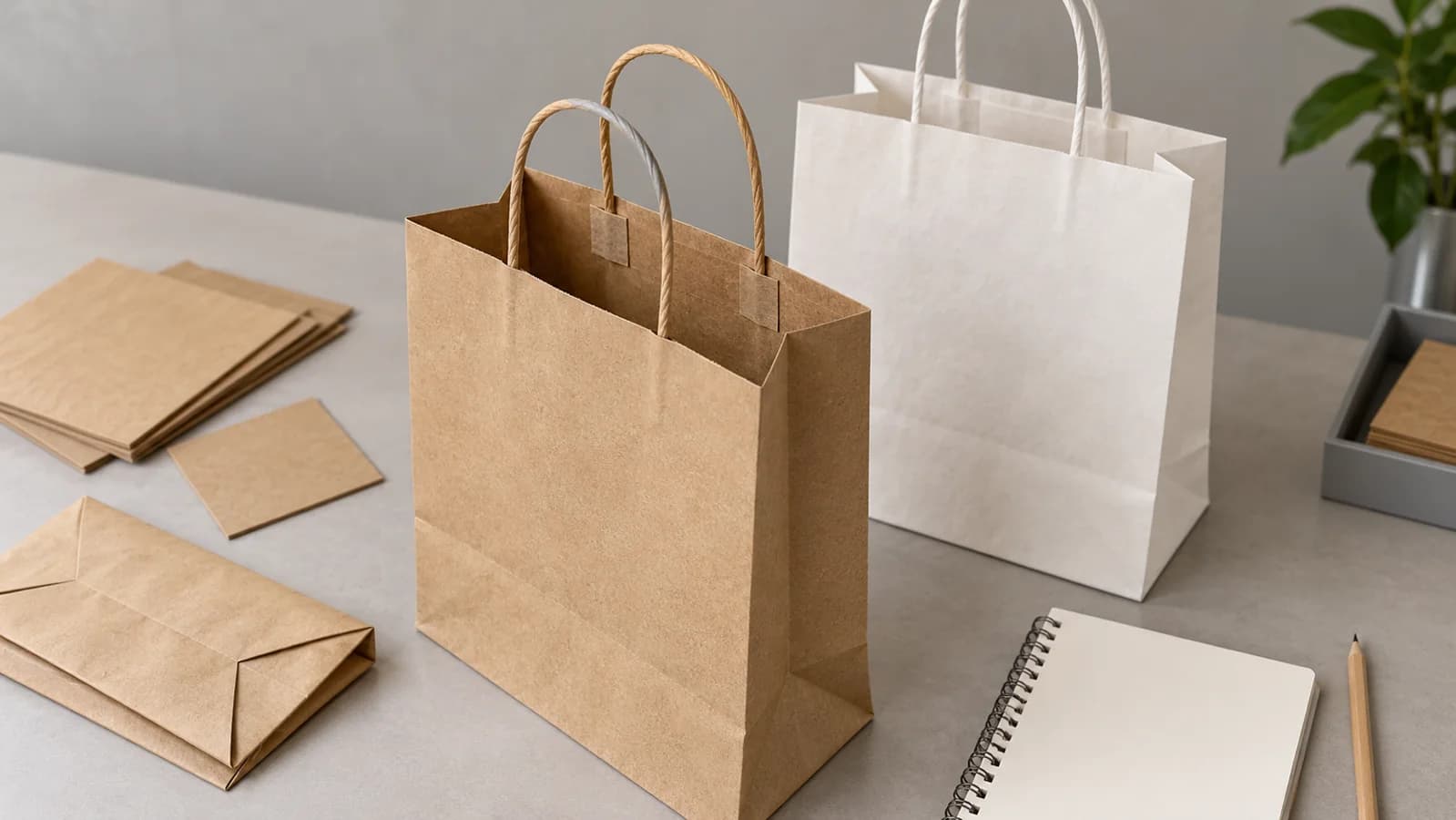
A kraft paper carrier bag can have an attractive printed surface and still disappoint when it is lifted. Before approving a paper grade, review the finished bag's handle attachment, seams and intended carrying conditions together. A quotation stating only the paper name and grammage leaves those assembly questions open.
Why this week's kraft-paper discussion matters to buyers
In an interview published on 7 October 2026, Mondi described balancing strength, extensibility, printability and processing in its Ad/Vantage kraft paper. The discussion concerns a specific industrial and consumer packaging grade; it does not establish the performance of every kraft carrier bag. Packaging Europe interview
The useful purchasing question is how those material properties translate into the converted item you will receive. For a retail bag, the trial must account for the handle and the joints as well as the sheet. Do not treat another manufacturer's grade description as evidence for a different supplier's material.
Examine the bag where the load is transferred
The Paper Bag's guidance, announced by EUROSAC in February 2023, identifies paper, glue, conversion and handle type as factors in carrier-bag quality. That older guidance provides assembly context for today's material-selection question. EUROSAC guidelines announcement
Use a representative converted sample to discuss three checkpoints with the bag maker:
Handle attachment
Record the handle material, attachment design and any reinforcing patch or folded top. During the agreed trial, note whether a problem occurs in the handle, at its attachment or in the surrounding paper. Photograph the location and preserve the sample. A generic statement that the paper is strong cannot explain which part of this assembly needs review.
Bottom and side seams
Identify the seam layout and the adhesive used in the sample. Ask the converter to document the relevant production conditions. If a joint opens, review the joint and conversion process before deciding that changing grammage is the appropriate remedy. Treat the observation as a question for investigation, not an automatic diagnosis of defective paper.
Contents and use conditions
Define the bag dimensions, intended contents and carrying weight with the customer. Include the shape of the contents and the expected handling route. Ask whether storage humidity or another foreseeable condition belongs in the evaluation. The converter or laboratory should select an appropriate method; a desk photograph does not demonstrate carrying capacity.
Make competing samples comparable
Agree the construction, contents, conditions and acceptance criteria before comparing grades. Keep the handle design and converting requirements consistent where possible, and record any differences. Include printing or finishing that is part of the actual order.
- Material identity: grade reference, grammage, format and available technical documents.
- Assembly identity: bag dimensions, handle design, reinforcement and seam reference.
- Evaluation scope: method, version, sample conditions and agreed acceptance criteria.
- Outcome: observed failure location, photographs and the converter's proposed follow-up.
- Approval: accepted sample reference and changes that require another review.
SIS describes EN 13590 as covering volume and carrying-capacity test methods for flexible carrier bags with handles. Its public scope notes supplier–buyer agreement for specific goods. Ask the laboratory to confirm the applicable edition and assessment scope. This article does not reproduce the method or establish a certification. SIS standard scope
This is our suggested purchasing record, not a substitute for that method. Avoid inventing a universal number of lifts or a guaranteed load from a GSM quotation. If samples use different handles or joints, explain the difference before ranking the paper grades.
Separate sample approval from production approval
For paper supplied to a separate bag converter, agree who checks the sheet, who makes the trial bags and who signs off the finished construction. Keep the approved material and bag references together. If the handle, adhesive, reinforcement, paper grade or finishing changes, request a review before extending the earlier approval.
When a sample fails, retain the evidence and ask the converter to propose a controlled follow-up. Changing several components at once makes it harder to understand what improved the result. These are suggested buyer controls, not test results or load guarantees for YoungSun products.
Prepare a useful material enquiry
Send the bag application, dimensions, handle design, intended contents and target carrying conditions. Add printing, finishing, supply format, quantity and destination. Attach the sample specification and identify the responsibilities of your converter.
Explore brown kraft paper and card, white kraft paper and card and the packaging-board family. Review packaging applications, then send your project requirements. These material references are starting points for grade selection; suitability for the proposed bag needs confirmation and a representative trial.
FAQ
Does a higher GSM guarantee a stronger carrier bag?
No guarantee follows from grammage alone. Review the exact grade, handle attachment, joints and finished-bag evaluation for the intended use.
Should I test a blank sheet or a finished bag?
Material documents help shortlist paper. Approve the converted bag with its actual handles, joints and finishing against agreed criteria.
Can changing the paper solve a handle failure?
It may be one option, but the failure location needs investigation. Ask the converter to review the handle, attachment and surrounding paper before choosing the next trial.