
Choose for two-sided reading, not GSM alone
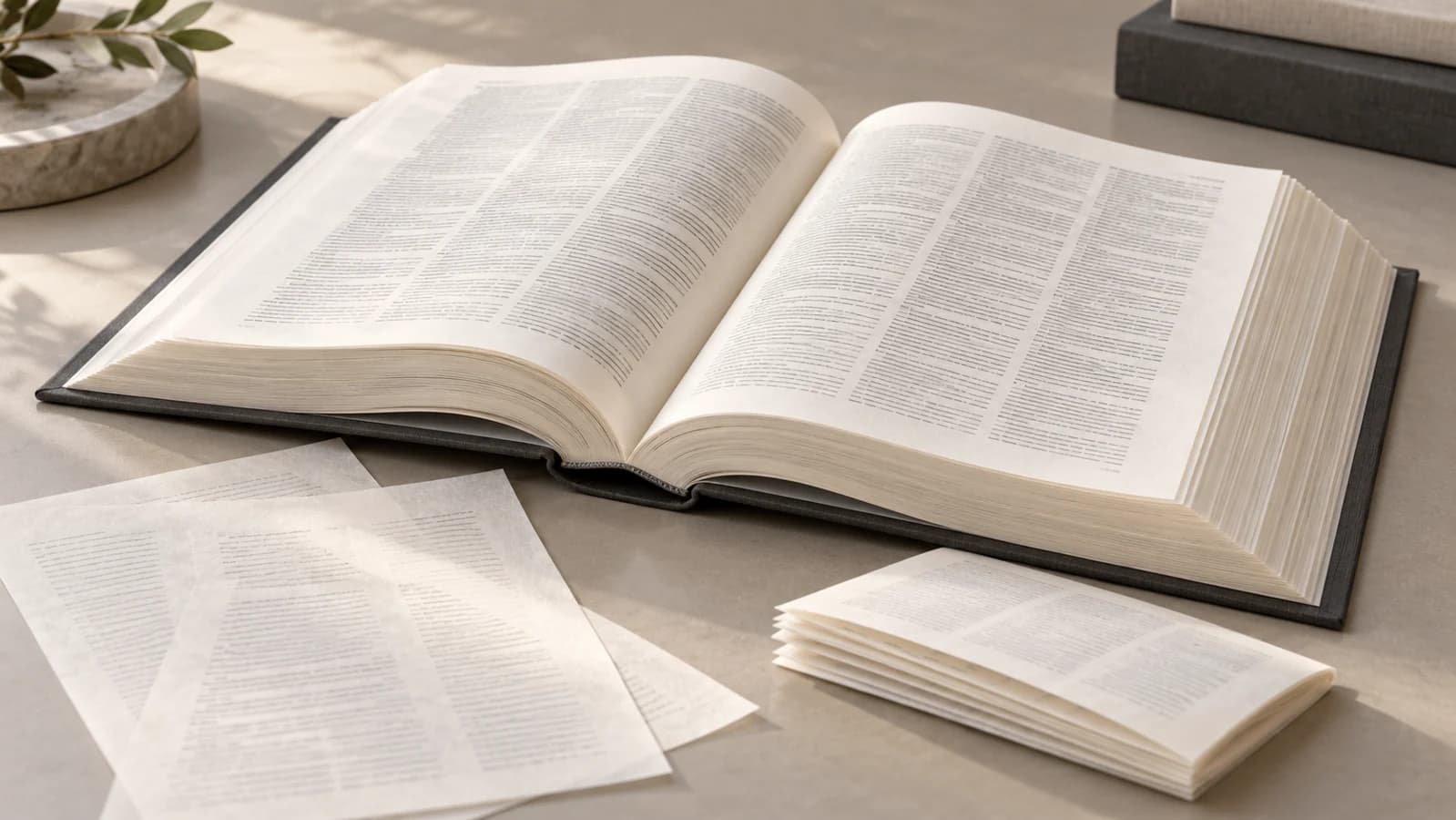
Bible paper should be selected by how the proposed grade works in the finished publication. Grammage helps define the material, but it cannot by itself approve reverse-side visibility, printed text clarity or the thickness of a bound book. Review a grade-specific specification alongside a representative two-sided printed sample.
For publishers and paper importers, the practical question is not simply “How light can we go?” It is “Which paper gives an acceptable reading experience within our book design?” This evergreen guide addresses that decision for compact reference books and other high-page-count publications.
Keep three different questions in the specification
Start with the Bible Paper product information, then separate the requirements you need to confirm:
- Grammage: the mass per unit area, expressed in g/m² or GSM. Record the nominated grade and agreed tolerance.
- Opacity: a measured optical property. Ask for the method and conditions behind a reported value.
- Printed-page appearance: the reading result with your text, illustrations, ink and layout on both sides.
These belong in the same evaluation, but they are not interchangeable approval criteria. Our procurement recommendation is to keep a physical reference for the printed result rather than approve a substitute only because its GSM matches the previous order.
Ask what an opacity number actually means
ISO 2471:2008 specifies a diffuse-reflectance method for determining paper opacity with paper backing. Its public scope also identifies limitations, including coloured papers incorporating fluorescent dyes or pigments. Ask the supplier or laboratory whether the reported method applies to the proposed grade. ISO 2471 public scope
For a useful comparison, request the method and edition, units, specimen condition and the identity of the tested grade. Ask whether a number is a typical published value, an agreed specification or a result for a particular sample. Do not combine figures from different methods into one supplier ranking without a technical review.
An opacity report does not set your editorial acceptance criteria. Agree separately what the publisher will accept on the printed page; this article supplies no universal minimum opacity or pass result for a YOUNGSUN grade.
Build a proof that can reveal reading problems
Use representative pages from the intended publication. A useful trial set can include dense small text, headings, a dark illustration and a relatively open page. Print both faces using the proposed process, preserving the intended placement of front and reverse artwork.
Ask the publisher, printer and buyer to review the same samples under consistent ordinary reading conditions. Assess text clarity and how distracting reverse-side content appears. Record the page references and the approved sample. If visible marks suggest ink penetration, ask the printer to investigate the cause rather than treating every reverse-side mark as the same problem.
Do not use a photograph of a sheet held against a bright window as the sole approval for a book normally read on a desk. Keep that kind of observation separate from the agreed reading review and from any laboratory measurement.
Confirm the printing route and the book block
Lightweight printing papers are offered as distinct grades. For example, delfort's gradefinder separately describes thinbook for publications and thinjet as a paper engineered for high-speed inkjet. This is evidence that the grade and process need attention, not proof that any YOUNGSUN paper has another manufacturer's performance or compatibility. delfort thinprint gradefinder
Name the press, ink system and intended finishing route when requesting a sample. Ask the printer to assess feeding, print quality and handling on the proposed material. A paper approved on one process should not automatically be released on another.
For book construction, request caliper or bulk information as appropriate and review a representative folded and bound dummy with the intended page count and trim size. Ask the bindery to confirm the book block and cover design. Do not calculate a final spine from GSM alone or treat an unbound stack as a complete binding approval.
Send an enquiry that supports a comparable offer
Include the publication type, page count, trim size, shade preference, proposed grammage, opacity requirement and measurement method. Add the printing process, artwork characteristics, sheet or reel dimensions and the sample review needed before production. Separate confirmed requirements from options you want the supplier to propose.
Explore the printing and culture paper range and application overview. Send your project requirements with the current specification and representative artwork. Confirm grade availability, supply format and acceptance criteria for the actual order.
Frequently asked questions
Does a higher GSM guarantee less show-through?
GSM alone cannot approve reading quality. Compare grade-specific opacity information and representative two-sided printed samples before choosing a paper.
Is an ISO opacity result a finished-book approval?
It is a material measurement under a defined method. Agree a separate printed-page and bound-book review for the actual artwork, printing process and book construction.
Can every Bible paper run on a digital press?
Do not assume universal compatibility. Identify the press and ink system, obtain grade-specific confirmation and arrange a representative production trial.