
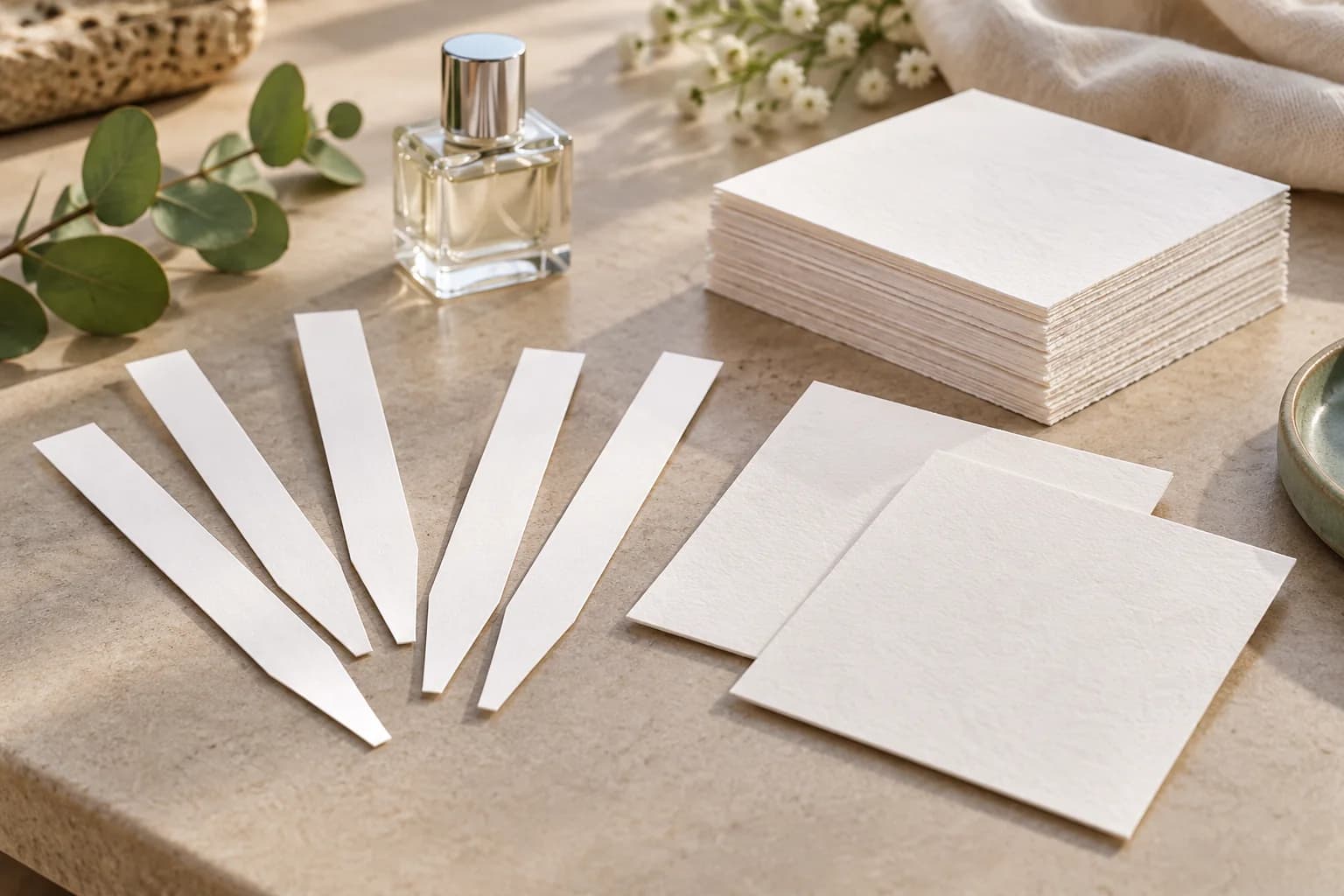
Before buying absorbent paper for a fragrance project, state whether the finished piece will help someone evaluate a perfume or carry a fragrance as part of a card or insert. These purposes can lead to different approval questions, even when both begin with an absorbent sheet.
For an evaluation strip, the buyer needs to discuss how the paper will be used as a smelling medium. For a scent card, the buyer may also need to approve appearance, stiffness, printing, cutting and the intended fragrance application. A material description or GSM value alone does not approve either result.
Name the application before requesting a grade
“Absorbent paper” is a broad description. It does not by itself mean perfumery-grade smelling paper, finished test strips, or a validated fragrance carrier. Put the application at the beginning of the enquiry rather than leaving the supplier to infer it from a sample photograph.
YOUNGSUN's Absorbent Board range lists scent cards and absorbent inserts among its applications and asks buyers to describe the fragrance, contact conditions and finished construction. That application listing is a starting point for a material discussion; the selected grade still needs approval in the intended process.
For a project involving professional scent evaluation, ask explicitly whether a proposed grade is offered and documented for that purpose. Do not treat the scent-card application as automatic proof of suitability for every evaluation task.
Separate the questions for strips and cards
| Intended piece | First question for the supplier | What the buyer should approve |
|---|---|---|
| Smelling or evaluation strip | Is this grade proposed for the intended fragrance-assessment use? | The paper and finished strip in the agreed evaluation procedure |
| Scented card or insert | Is the grade proposed for this fragrance and converting route? | The finished construction, appearance and fragrance application |
| Printed promotional piece | Which printing and finishing operations are included? | Both the unprinted material and the processed sample |
| Replacement material | What differs from the previously approved material? | A comparison with an identified reference under agreed conditions |
This is a purchasing checklist, not a standard test method. The person responsible for the fragrance evaluation should define the relevant acceptance requirements with the material supplier and converter.
Ask for blank and processed samples
A blank sample lets the buyer examine the proposed paper before printing or fragrance application. A processed sample answers questions about the actual finished piece. Identify them separately so that a change in printing, packing or fragrance application is not silently treated as a change in the base paper.
As an editorial comparison plan, retain an unexposed sample from the proposed batch and identify the material, process stage and packaging for each comparison. If an unwanted background odour is noticed, record where and when it was observed and ask for investigation. That observation alone does not identify its cause or establish a numerical acceptance limit.
LS Materials' smelling-strip product information describes papers for fragrance assessment and packaging chosen to prevent odour contamination. This shows why both intended use and sample protection belong in the enquiry; it does not establish the properties of YOUNGSUN paper or prescribe a packing format for an order.
Keep the comparison conditions consistent
Record the fragrance identity, application method, intended contact area, evaluation sequence and agreed observation times. Let the project team choose the relevant procedure; this guide does not specify a universal dose, waiting period or scent-retention duration.
Keep comparison samples identifiable and separate. Pairfum's guide to perfume evaluation advises keeping scented strip tips apart so different perfumes do not contact one another. Apply that observation as a handling consideration, not a validated material test.
When comparing a new paper with an existing reference, avoid changing the fragrance, application and converting route at the same time. Otherwise the result may be difficult to interpret. If a project intentionally changes several elements, record those changes instead of describing it as a direct paper substitution.
Make the quotation match the approval scope
Send the supplier the intended use, requested sheet or finished-piece format, grade options, converting route, fragrance-contact conditions, sample quantities and packing expectations. Explain which operations the paper supplier will provide and which belong to another converter.
Agree who approves the paper and who approves the fragrance result. Record unresolved items as questions, not assumed capabilities. Confirm the chosen grade, supply form and order requirements before treating a trial sample as a purchase specification.
Browse Packaging Paper & Board, or send YOUNGSUN your application requirements. For a fragrance project, describe the finished piece rather than relying only on the general term absorbent paper.
Buyer questions
Is scent-card paper automatically suitable for professional perfume evaluation?
No automatic equivalence should be assumed. Ask whether the proposed grade is documented for the intended evaluation use and approve it with the people responsible for that procedure.
Can GSM alone define scent retention or paper neutrality?
GSM alone does not establish either result. Define the required application and acceptance procedure, and review the selected material and finished sample without inventing a universal performance value.
What should be kept for a repeat order?
Keep the identified approved material, relevant unexposed sample, finished sample, artwork or process revision and agreed packing requirements. Record any change before approving a substitute.